This article focuses on case study of a Mexican company GB PLUS, S.A. DE C.V. The company operates in the Payroll discount financing industry. They sell cash loans, electronics and business start-ups to syndicated personnel that work for the federal and states governments in México, and get paid via a discount on their payroll. 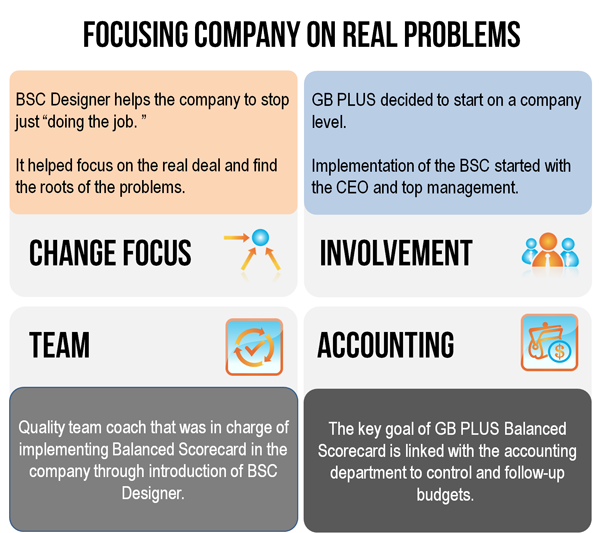
Start of implementation process. Who is in charge?
José Ricardo Zea Grayeb is quality team coach that was in charge of implementing Balanced Scorecard in the company through introduction of BSC Designer. The company made a decision to attract external advisors. But at the same time they tried to do everything they can do using internal human resources. So, a special team was formed in order to convey business goals into indicators. This team was in charge of strategic planning, it set of own goals, and team leader was in charge of transforming those goals into indicators. As already said above, the company was aided by external consultants to keep focused with an outsider vision.
It should be mentioned that attraction of external advisors in implementation of Balanced Scorecard is quite popular. In fact, statistics show that there are few companies that really succeeded in implementation of Balanced Scorecard without professional assistance.
As known, implementation of Balanced Scorecard needs proper tech support and software solutions. Luckily, GB PLUS has its own IT department that provided BSC team and company personnel with proper support. But still, the company has to outsource sometimes. At the same time, they have own qualified IT specialists that develop software and utilities.
Scope of implementation
It is well known, that some companies prefer to implement the Balanced Scorecard on a company level, while others choose to start with the department or business unit. GB PLUS decided to start on a company level. Implementation of the Balanced Scorecard started with the CEO and top management. Then the process comes down to lower levels of organization structure. Company specialists estimated that they need a month to spread BSC in the entire organization. GB PLUS use quite an interesting scheme how Balanced Scorecard works. Most of company employees are field operatives (sales people). So, they are a major source of information. Warehouses and other departments also provide company top management with the information that is automatically processed by software solution. Then, this information enters the BSC system. It should be noted that this is a very popular way of gathering information, since ordinary employees, front line managers and sales people always have accurate information on internal and external processes, customer needs, problems inside and outside the company, etc.
Maintenance of Balanced Scorecard. Strategic planning. Roll of Balanced Scorecard in the company
GB PLUS has reported that Balanced Scorecard concept and BSC Designer helps the company to stop just “doing the job. ” It helped focus on the real deal and find the roots of the problems. With Balanced Scorecard, a strategy is formalized based on current problems and operations. In fact, this is the best thing Balanced Scorecard can do with the company. It changes approaches and attitudes. If the Balanced Scorecard becomes a part of company everyday routine it means that BSC really works. If strategy becomes everyone’s concern, there is every reason to hope that strategic goals will be achieved. In such a way Balanced Scorecard is not just a toy in hands of top-managers, but an effective tool for strategic management used by everyone in the company.
Business activity monitoring
As already said above, Balanced Scorecard does not only transfer strategy into action but also helps to collect information about business activities and problems. In GB PLUS BSC is being implemented at its initial stages, so they haven’t got the chance to test it. At the same time, company top management and personnel is doing everything possible to have balance scorecard work as a tool to collect information and monitor business activity. One of the key company goals is to provide investors, directors, managers and employees with a visual representation of the management system, linked to all sources of information. Sometimes, it is very difficult for ordinary employees to understand company strategy. It happens that investors and company owners always want to know what happens in the company. BSC is a perfect a solution in this sense, since it provides all users with accurate and reliable information on company internal and external processes, as well as its progress on the way to achieve goals.
Measurement of internal processes indicators
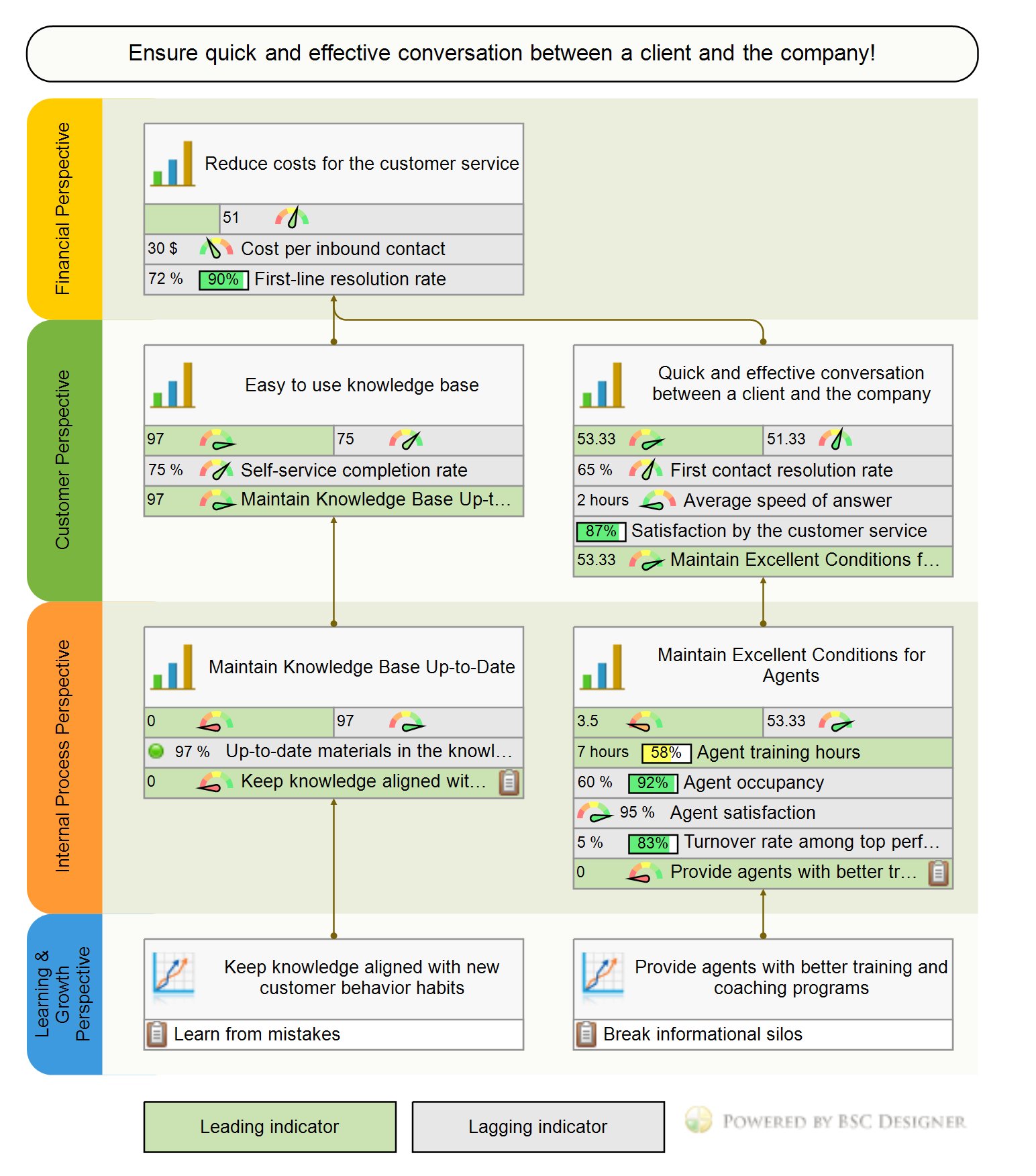
The key goal of GB PLUS Balanced Scorecard is linked with the accounting department to control and follow-up budgets. The second most important idea is to see how effective internal processes are, and how they can contribute to customer satisfaction, so that the company does everything possible to meet customer demands. This example explains efficiency of Balanced Scorecard. Strategy maps consist of measures and goals linked by cause and effect ties. So, in order to improve customer satisfaction and make them buy more from the company, certain improvements need to be performed the company internal processes. Sometimes it is necessary to educate personnel, acquire new skills and approaches and change the way business is done. Customers are supreme value for any business. And it is only through customer satisfaction and loyalty that sales are increased and better financial results are obtained.
BSC Designer used for education and growth processes
GB PLUS managed to use BSC Designer to measure human resource management, efficiency of compensation systems and training sessions. The company needs much organizational development and GB PLUS intends to use BSC Designer to improve efficiency of personnel, especially in human resource management. They have to monitor all training processes and compensation policies since they pay commission to sales people. So, their sales performance should be controlled in order to calculate the amount of bonuses. It should be mentioned that Balanced Scorecard just doesn’t work without personnel being motivated. Motivation can be different in different companies. But anyway, a comprehensive reward and bonus system is a must. People need to understand why they should use Balanced Scorecard and what benefits they get personally.
Expectations as to Balanced Scorecard in the company
GB PLUS managers confess that they are expecting to regain stability, to increase profits and to further develop. The key company goal is to be able to know what they’re doing in real time. Since there are able to track performance they can offer such information to investors who love knowing what is going on with the companies they invested. In such a way investors feel secure and protected. The companies are planning to use web based solutions to offer information to all interested parties.
Experience with Balanced Scorecard and BSC Designer
Timeline
The company set up at 90 days timeline for trials and then another 60 days to link up their sources of information and publish BSC data are on their website. GB PLUS is in the set up phase now, so they don’t have the full picture regarding technical needs. For the meantime, the company is already using Accounting Software as well as credit evaluation application that will be attached to BSC. Everything is done with SQL. The company maintains close relations with suppliers, so problems are solved as soon as they occur.
Strategy maps
GB PLUS is about to complete their strategy map and they plan to use BSC Designer to keep track of everything. The company has developed its own indicators, so there are no imported KPIs. All of our information is prepared in-demand by the current department responsible, but they need to change this because it is a slow and imprecise process and the information is often outdated or somewhat unreliable.
Reports and BSC
GB PLUS uses Excel and Power Point reports, but the company management wants improvement in the reporting process. The company hasn’t used reporting capabilities of BSC Designer and they have no experience in using custom formulas. GB PLUS chose BSC Designer because it has these capabilities and that is what they’re looking for. Company management realizes that Balanced Scorecard will be useless if information cannot be accessed in real time. BSC Designer has become a good choice for GB PLUS since it offers on-time access to information and has an excellent reporting system. This makes managerial decision-making much easier. To sum it up, from this case study it is evident that GB PLUS clearly understood the benefits of Balanced Scorecard and BSC Designer. The company is only making first steps in BC implementation and has already achieved some positive results.
More case studies with Mexico-based clients
- We use BSC Designer for measuring and reporting of KPIs an Balanced Scorecard. Alberto Torres, Project Management, UAEM, Toluca, Mexico;
- Ivan Rivera, PMP, Progect Manager, Mexico uses BSC Designer to identify what projects contribute toward the business vision and mission achievement;
- Ricardo Zea Grayeb, CFG SAPI DE CV, Xalapa, Veracruz, Mexico uses BSC Designer to visually track performance and quality;
More Examples of the Balanced Scorecard

BSC Designer is strategy execution software that enhances strategy formulation and execution through KPIs, strategy maps, and dashboards. Our proprietary strategy implementation system guides companies in practical application of strategic planning.